Wer heiratete Annia Faustina?
Pomponius Bassus heiratete Annia Faustina .
Elagabal heiratete Annia Faustina im Jahre .
Die Ehe endete . Grund: Scheidung
Annia Faustina

Annia o Ania Aurelia Faustina fue una emperatriz de Roma y tercera esposa del emperador Heliogábalo durante un corto período en el año 221. Era la bisnieta de Marco Aurelio.
Lesen Sie mehr...
Pomponius Bassus
Pomponius Bassus war ein römischer Politiker und Senator Anfang des 3. Jahrhunderts.
Sein Vater war wahrscheinlich Gaius Pomponius Bassus Terentianus, Suffektkonsul um 193. Bassus war 211 ordentlicher Konsul und zwischen 212 und 217 Legat von Mösien (inferior oder superior).
Bassus war mit Annia Faustina verheiratet, die von dem Konsul Claudius Severus abstammte, dem Schwiegersohn des Kaisers Mark Aurel. Wahrscheinlich war sie eine Urenkelin Mark Aurels und seiner Gattin Annia Galeria Faustina, die als Faustina die Jüngere bekannt ist. Bassus’ Schwiegervater war wohl der Sohn des Claudius Severus, Tiberius Claudius Severus Proculus, der im Jahr 200 das ordentliche Konsulat bekleidete. Nachfahren, möglicherweise Enkel, des Pomponius Bassus und der Annia Faustina waren wahrscheinlich Pomponia Ummidia und der Konsul des Jahres 271, Pomponius Bassus.
Kaiser Elagabal beschuldigte Bassus, er habe kaiserliche Maßnahmen kritisiert. Dies wurde als Hochverrat betrachtet. Daher ließ Elagabal Bassus töten. Das Todesurteil ließ er nachträglich vom Senat verhängen. Dabei verzichtete er auf die Angabe von Beweisen für den angeblichen Hochverrat und begründete dies damit, dass der Konsular bereits tot sei. Der zeitgenössische Geschichtsschreiber Cassius Dio behauptet, Elagabal habe den Tod des Bassus angeordnet, um Annia heiraten zu können, die „schön und von vornehmer Herkunft“ gewesen sei, und er habe ihr keine Trauer um ihren ersten Gatten erlaubt. Nach neueren Forschungsergebnissen fand die Hinrichtung jedoch sehr früh statt, schon bevor Elagabal, der im Mai 218 in Syrien zum Kaiser erhoben worden war, im Sommer 219 in Rom eintraf. Der wirkliche Grund für die Beseitigung des Bassus war somit nicht der erst später gefasste Heiratsplan des Kaisers. Vermutlich befürchtete Elagabal, Bassus könne aufgrund seiner Ehe mit einer Nachfahrin Mark Aurels Anspruch auf die Kaiserwürde erheben.
Lesen Sie mehr...Annia Faustina
Elagabal
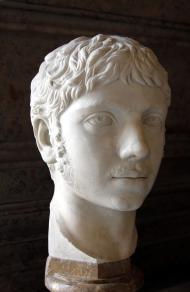
Marcus Aurelius Antoninus (born Sextus Varius Avitus Bassianus, c. 204 – 13 March 222), better known by his posthumous nicknames Elagabalus ( EL-ə-GAB-ə-ləs) and Heliogabalus ( HEE-lee-ə-, -lee-oh-), was Roman emperor from 218 to 222, while he was still a teenager. His short reign was notorious for religious controversy and alleged sexual debauchery. A close relative to the Severan dynasty, he came from a prominent Syrian Arab family in Emesa (Homs), Syria, where he served as the head priest of the sun god Elagabal from a young age. After the death of his cousin, the emperor Caracalla, Elagabalus was raised to the principate at 14 years of age in an army revolt instigated by his grandmother Julia Maesa against Caracalla's short-lived successor, Macrinus. He only posthumously became known by the Latinised name of his god.
Elagabalus is largely known from accounts by the contemporary senator Cassius Dio who was strongly hostile to him, Herodian, who likely relied extensively on Dio, and the much later Historia Augusta. The reliability of the accounts of Cassius Dio and the Historia Augusta, particularly their most salacious elements, has been strongly questioned. Elagabalus showed a disregard for Roman religious traditions. He brought the cult of Elagabal (including the large baetyl stone that represented the god) to Rome, making it a prominent part of religious life in the city. He forced leading members of Rome's government to participate in religious rites celebrating this deity, presiding over them in person. According to the accounts of Cassius Dio and the Augusta, he married four women, including a Vestal Virgin, in addition to lavishing favours on male courtiers they suggested to have been his lovers, and prostituted himself. His behaviour estranged the Praetorian Guard, the Senate, and the common people alike. Amidst growing opposition, at just 18 years of age he was assassinated and replaced by his cousin Severus Alexander in March 222. The assassination plot against Elagabalus was devised by Julia Maesa and carried out by disaffected members of the Praetorian Guard.
Elagabalus developed a posthumous reputation for extreme eccentricity, decadence, zealotry, and sexual promiscuity. Among writers of the early modern age, he endured one of the worst reputations among Roman emperors. Edward Gibbon, notably, wrote that Elagabalus "abandoned himself to the grossest pleasures with ungoverned fury". According to Barthold Georg Niebuhr, "the name of Elagabalus is branded in history above all others; [...] "Elagabalus had nothing at all to make up for his vices, which are of such a kind that it is too disgusting even to allude to them". An example of a modern historian's assessment is Adrian Goldsworthy's: "Elagabalus was not a tyrant, but he was an incompetent, probably the least able emperor Rome had ever had". Despite near-universal condemnation of his reign, some scholars write warmly about his religious innovations, including the 6th-century Byzantine chronicler John Malalas, as well as Warwick Ball, a modern historian who described him as "a tragic enigma lost behind centuries of prejudice".
Modern scholars have questioned the accuracy of Roman accounts of his reign, with suggestions that the reports of his salacious behaviour and sexual excess likely reflected a desire to politically discredit him in the immediate aftermath of his death, as well as reflecting Roman stereotypes regarding people from the Orient as effeminate.
Lesen Sie mehr...