Wer heiratete Maria Theresa?
Francis I, Holy Roman Emperor heiratete Maria Theresa am . Maria Theresia war am Hochzeitstag 18 Jahre alt (18 Jahre, 8 Monate und 30 Tage). Francis I, Holy Roman Emperor war am Hochzeitstag 27 Jahre alt (27 Jahre, 2 Monate und 4 Tage). Der Altersunterschied betrug 8 Jahre, 5 Monate und 5 Tage.
Maria Theresa: Zeitachse des Ehestatus
1 Pixel = 1 Month

Maria Theresa
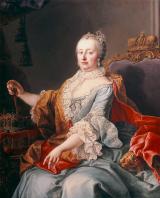
Maria Theresa (Maria Theresia Walburga Amalia Christina; 13 May 1717 – 29 November 1780) was the ruler of the Habsburg monarchy from 1740 until her death in 1780, and the only woman to hold the position in her own right. She was the sovereign of Austria, Hungary, Croatia, Bohemia, Transylvania, Slavonia, Mantua, Milan, Moravia, Galicia and Lodomeria, Dalmatia, Austrian Netherlands, Carinthia, Carniola, Gorizia and Gradisca, Austrian Silesia, Tyrol, Styria and Parma. By marriage, she was Duchess of Lorraine, Grand Duchess of Tuscany, and Holy Roman Empress.
Maria Theresa started her 40-year reign when her father, Charles VI, Holy Roman Emperor, died on 20 October 1740. Charles VI paved the way for her accession with the Pragmatic Sanction of 1713 and spent his entire reign securing it through international diplomacy. He neglected the advice of Prince Eugene of Savoy, who believed that a strong military and a rich treasury were more important than mere signatures. Eventually, Charles VI left behind a weakened and impoverished state, particularly due to the War of the Polish Succession and the Russo-Turkish War (1735–1739). Moreover, upon his death, Saxony, Prussia, Bavaria, and France all repudiated the sanction they had recognised during his lifetime. Frederick II of Prussia (who became Maria Theresa's greatest rival for most of her reign) promptly invaded and took the affluent Habsburg province of Silesia in the eight-year conflict known as the War of the Austrian Succession. In defiance of the grave situation, she managed to secure the vital support of the Hungarians for the war effort. During the course of the war, Maria Theresa successfully defended her rule over most of the Habsburg monarchy, apart from the loss of Silesia and a few minor territories in Italy. Maria Theresa later unsuccessfully tried to recover Silesia during the Seven Years' War.
Although she was expected to cede power to her husband, Emperor Francis I, and her eldest son, Emperor Joseph II, who were officially her co-rulers in Austria and Bohemia, Maria Theresa ruled as an autocratic sovereign with the counsel of her advisers. She promulgated institutional, financial, medical, and educational reforms, with the assistance of Wenzel Anton of Kaunitz-Rietberg, Friedrich Wilhelm von Haugwitz, and Gerard van Swieten. She also promoted commerce and the development of agriculture, and reorganised Austria's ramshackle military, all of which strengthened Austria's international standing. A pious Catholic, she despised Freemasons, Jews and Protestants, and on certain occasions she ordered their expulsion to remote parts of the realm. She also advocated for the Catholic Church.
Lesen Sie mehr...
Francis I, Holy Roman Emperor
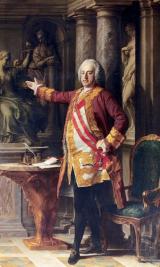
Franz Stephan von Lothringen (* 8. Dezember 1708 in Nancy; † 18. August 1765 in Innsbruck) war von 1729 bis 1736 als Franz III. Herzog von Lothringen und Bar, anschließend ab 1737 als Franz II. Großherzog der Toskana und ab 1745 als Franz I. Kaiser des Heiligen Römischen Reiches.
Franz Stephan heiratete 1736 Erzherzogin Maria Theresia von Österreich, die einzige Erbin Kaiser Karls VI., und begründete mit ihr das Haus Habsburg-Lothringen. Seit 1740 war er ihr Mitregent in den Habsburgischen Erblanden, wurde aber kaum an den Regierungsgeschäften beteiligt. Daher widmete er sich erfolgreichen Finanzgeschäften und der Förderung der Naturwissenschaften.
Lesen Sie mehr...